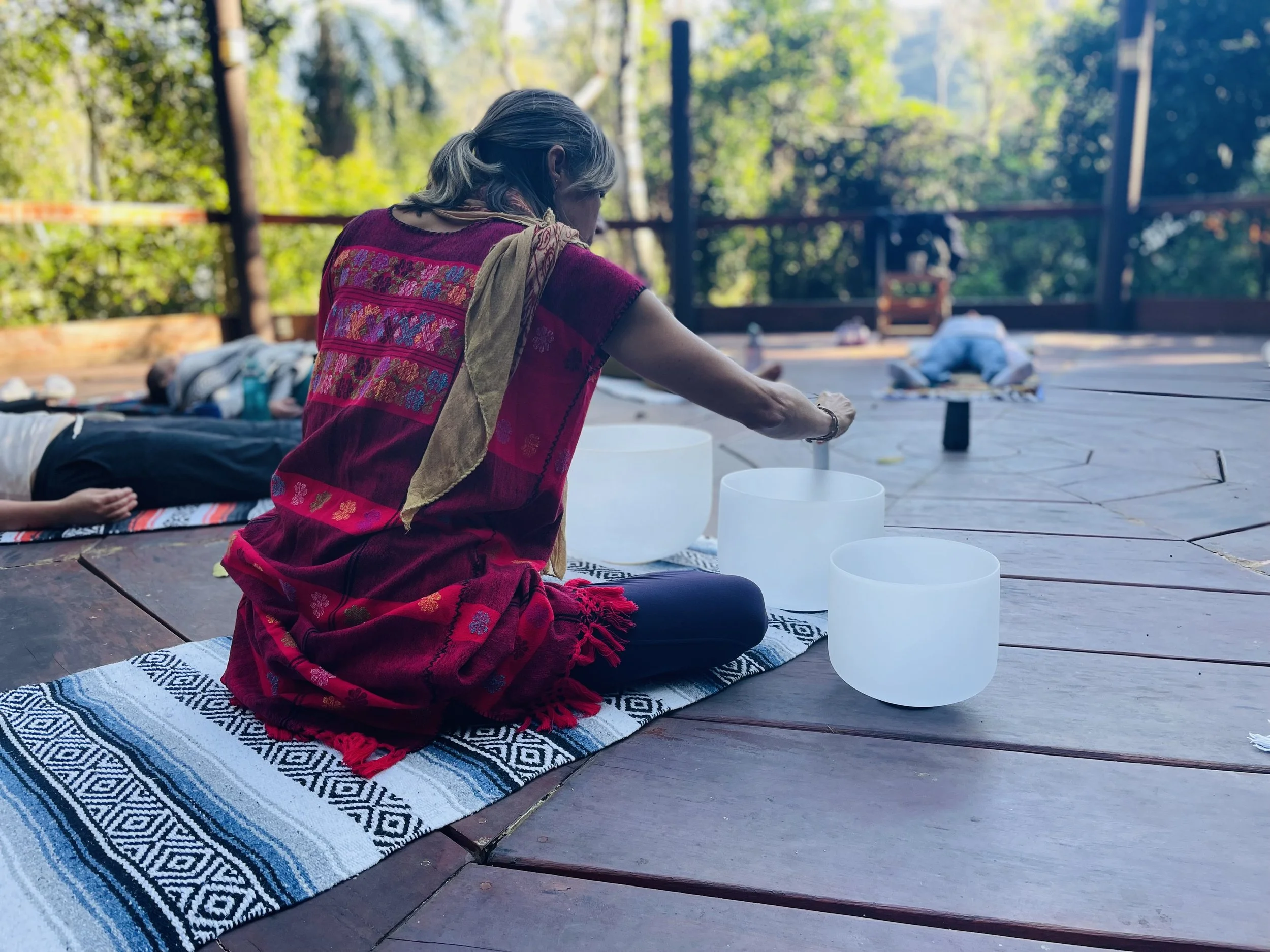
Therapeutic Sound Healing
Come back to rhythm.
Therapeutic Sound Healing invites the body back into rhythm.
Just as the natural world moves through its own cycles, the rhythm of ocean tides, the rustling of leaves, the pulse of rain, the resonance of birdsong, our bodies carry their own natural rhythms.
Through sound, vibration, rhythm, and deep listening, Therapeutic Sound Healing creates a space where the body and nervous system can soften, settle, and return toward a more natural state of balance.


Sound can become a doorway into stillness.
Stress, overwhelm, and the demands of modern life can pull us away from our natural rhythms, leaving us feeling tense, scattered, disconnected, or unable to fully rest.
Sound healing is more than simply listening to beautiful or relaxing sounds. It is an embodied experience of vibration and resonance, an opportunity to experience sound not only through the ears, but through the body itself.
Through tones, vibration, rhythm, and deep listening, sound can create a supportive environment in which the body has an opportunity to soften and the nervous system can begin moving toward greater rest and regulation.
Creating space for the body to settle.
Mental Overactivity
Sound can give attention something gentle and rhythmic to rest upon, creating space from the constant movement of thought.
Inner Tension
Resonance and vibration can invite awareness into areas of physical holding and support a gradual softening.
Emotional Overwhelm
Sound provides a sensory experience that does not require you to explain, analyze, or understand everything you are feeling.
Difficulty Slowing Down
Predictable tones and rhythms can create a gentle transition away from external stimulation and toward inward attention.
Disconnection From the Body
Vibration and resonance can encourage a deeper awareness of sensation, breath, and the felt experience of being present.
Difficulty Resting
A therapeutic sound session can offer a dedicated space to pause, receive, and allow the body to experience stillness.
As the sounds surrounded me, I noticed my breath deepen and my whole body begin to soften.LAURA · SOUND HEALING SESSION
Returning to rhythm.
Everything in nature has rhythm.
The rising and falling of waves. The movement of wind through trees. The changing seasons. The steady pulse of day becoming night.
Our bodies are part of this same natural world.
When we experience prolonged stress, our internal rhythms can become disrupted. We may remain mentally busy, physically tense, or emotionally guarded long after the original stress has passed.
Therapeutic sound offers a gentle invitation to pause.
Through tones, rhythms, vibrations, and intentional listening, sound can create an environment where the nervous system has an opportunity to settle and the body can become more aware of its own natural pace.
As the body relaxes and attention becomes less externally focused, brain activity may also shift. During deeply relaxed, meditative, or inward-focused states, the brain can show increased activity in slower-frequency patterns, including theta waves.

The space between waking and dreaming.
Theta is a slower brainwave frequency associated with states such as deep relaxation, meditation, inward attention, creativity, memory processing, and the transition between wakefulness and sleep.
Theta activity is a natural part of the brain's rhythms. It is not something that needs to be forced or achieved.
For some people, therapeutic sound may help create the conditions for this kind of deeply relaxed, inward state by providing rhythmic and predictable sensory input, reducing mental stimulation, and giving attention something gentle to rest upon.
This can feel like the space between waking and dreaming, a place where the thinking mind becomes quieter and awareness turns inward.
These experiences vary from person to person. Sound does not guarantee a particular brainwave state, and therapeutic sound is not about trying to manipulate the brain. Rather, it creates a supportive environment in which the nervous system may naturally move toward greater rest and regulation.
Sound offers another language.
Emotions live in the body as much as they live in the mind.
Grief can feel heavy in the chest. Fear can tighten the belly. Stress can gather in the shoulders and jaw. Sometimes what we cannot put into words can still be felt as sensation, tension, movement, or energy.
Sound does not require us to explain, analyze, or understand what we are experiencing. Instead, we are invited to listen and notice.
- Softening physical and emotional tension
- Bringing awareness into the body
- Creating space for feelings to move naturally
- Supporting relaxation and nervous system regulation
- Reconnecting with sensations that may have been overlooked or held

Remembering the rhythms of the living world.
Sound is woven into the living world.
The ocean has its rhythm. Birds communicate through song. Thunder moves across the sky. Trees whisper in the wind. Even silence has its own quality and presence.
For thousands of years, cultures around the world have used voice, rhythm, percussion, chanting, bells, drums, and other forms of sound in ritual, ceremony, meditation, and contemplative practices.
Therapeutic Sound Healing draws from this deep human relationship with sound while creating a gentle space for personal exploration and embodied awareness.
A gentle pathway into stillness.
The natural world rarely rushes.
There is a rhythm to growth, to rest, to decay, and to renewal. The body knows these rhythms too.
When we have lived in states of constant activity or alertness, slowing down can sometimes feel unfamiliar. Therapeutic sound offers a gentle sensory pathway into stillness, giving the body permission to pause without demanding that it immediately let go.
- Encouraging deeper breathing and physical relaxation
- Providing steady and rhythmic sensory experiences
- Creating space between thoughts
- Bringing attention back into the body
- Supporting integration after somatic practices
- Offering a gentle transition from activation into rest
The relationship between sound and the nervous system is both sensory and physiological. Sound enters through the auditory system and interacts with networks involved in attention, emotion, arousal, and autonomic regulation.
For those engaged in deeper somatic work, sound can become a kind of container for what is emerging.
There is no need to force, perform, or figure everything out.
Turning attention inward.
One of the most beautiful qualities of therapeutic sound is its ability to support a shift in our relationship with attention.
In everyday life, attention is constantly pulled outward, toward conversations, screens, responsibilities, thoughts, and unfinished tasks.
During a sound session, attention can gradually turn inward.
The repetitive nature of rhythm, the sustained resonance of certain instruments, and the invitation to simply listen can create a meditative quality.
Rather than viewing these states as something to chase, they can be understood as natural expressions of the nervous system moving into a different mode of awareness.
The goal is not to “reach theta.”
The goal is to create enough safety, stillness, and spaciousness for the body to find its own rhythm.
Like water finding its way around a stone, the experience can unfold at its own pace.
What Therapeutic Sound Healing is & is not.
Therapeutic Sound Healing is
- A gentle, non-invasive complementary practice
- Supportive of relaxation, embodiment, and self-awareness
- A practice that can create conditions conducive to meditative and deeply relaxed states
- An invitation to connect with the body and the natural rhythms of life
- A practice that does not require a particular belief system
- A supportive companion within a broader therapeutic and holistic process
Therapeutic Sound Healing is not
- A practice that forces emotional release
- A replacement for medical or psychological care
- Intended to diagnose or treat medical conditions
- A guarantee of a particular brainwave state
- Something you need to perform or achieve
- About forcing the body to heal

Sometimes healing begins with listening.
To feel the breath. To notice what has been held. To soften what is ready to soften. And, little by little, to remember the rhythm that was there all along.
Book a Sound Healing Session